


The New Agency Partner Model (What This Actually Looks Like)
For years, the agency–client relationship followed a simple pattern:
You owned the work. They owned the approval. Everyone hoped the retainer made the math work.
That model breaks the moment a client begins in-housing.
Not because they want you gone—but because the old in-house vs agency workflow can’t support the speed, data access, and decision velocity they now expect. What you need is a hybrid delivery model for agencies—one that matches how brands actually operate.
That model is the Hybrid Systems Partner Model.
It’s not a mindset shift. It’s an operational shift—built around who owns what.
What In-House Teams Own
- Day-to-day execution
Content production, campaign tweaks, channel-level optimization.
- Internal alignment
Brand voice, compliance, stakeholder sign-off.
- Rapid experimentation
Quick tests that require proximity, context, and speed.
What Agencies Continue to Own
- Specialized depth
Complex builds, cross-platform reporting, AI-integrated workflows, technical SEO, headless architecture.
- Strategic pattern recognition
Insights across multiple clients and verticals—something no single in-house team can replicate.
- Quality safeguards
Standards, governance, and frameworks that stabilize performance.
What Gets Co-Owned
This is the new center of gravity—the layer where agencies stay indispensable:
- Systems (dashboards, workflow tooling, QA frameworks)
- Data (shared reporting, attribution logic, experimentation libraries)
- Decisions (roadmaps, prioritization, quarterly planning)
This is the part most agencies ignore—and the part brands cannot build alone.
Old Model vs Full In-House vs Hybrid Systems Partner Model
| Capability | Old Agency Model | Full In-House | Hybrid Systems Partner Model |
|---|---|---|---|
| Strategy | Agency-led, slow to update | Internal-only, limited perspective | Shared: agency brings patterns, in-house brings context |
| Execution | Agency-owned | Mostly internal | Split: internal handles velocity, agency handles complexity |
| Data | Fragmented and external | Internal but shallow | Co-owned, unified, decision-ready |
| Speed | Slower (handoffs, approvals) | Fastest | Fast, but with fewer errors and clearer standards |
| Risk | High (scope creep, delays) | High (skill gaps, burnout) | Lowest—each side owns what they’re best at |
| Innovation | Dependent on agency | Dependent on internal capability | Continuous—specialists + operators working in one system |
This is the first agency in-housing strategy that reflects how clients actually build teams today. It reduces risk, increases speed, and protects margin by reducing the amount of work agencies do that clients believe they can do themselves.
And this is exactly where a behind-the-scenes partner like White Label IQ fits—quietly carrying the complex design, development, and marketing work so your agency can lead the strategic and systems layer without adding headcount, overhead, or burnout.
Play 1 — Partner Up
Most agencies treat in-housing like a turf war. The smart ones treat it like a workflow redesign.
Partner Up doesn’t mean being “collaborative” or “easy to work with.”
It means redesigning the in-house vs agency workflow so you stay inside the client’s system—where decisions are made, not where tasks are handed off. It’s the first move in any serious agency in-housing strategy because it shows the client you can move faster with them, not against them.
When to Use This Play
This play becomes your leverage the moment a client:
- Hires an internal strategist, PM, or performance lead
- Asks for access to your dashboards, assets, or processes
- Starts routing small requests internally while keeping big ones with you
- Complains about speed, visibility, or coordination
- Mentions wanting a “hybrid” workflow
These are not threats. They’re invitations—to step inside their system instead of defending your old one.
If you want a deeper understanding of how to guide internal conversations during shifts like this, read Talking AI to Your Team — it shows exactly how leaders steady the culture during change.
How to Execute This Play
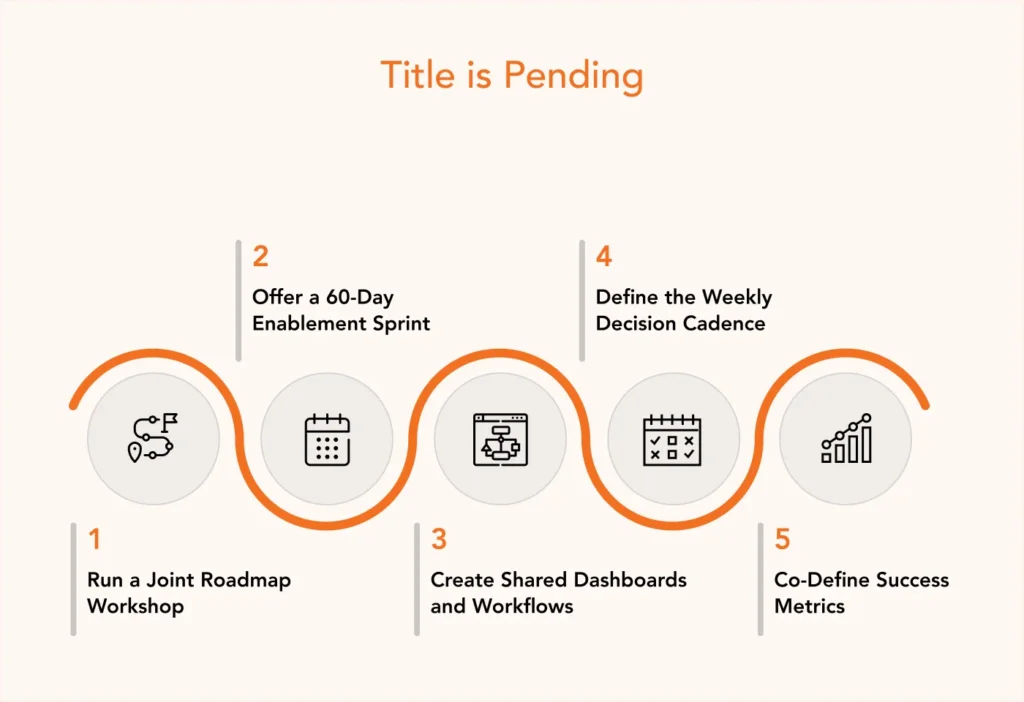
These are real operator moves—not theory:
-
Run a Joint Roadmap Workshop
Rebuild the quarterly plan together. Clarify who owns what and highlight where complexity still requires your depth.
-
Offer a 60-Day Enablement Sprint
Train their new internal team on standards, QA, naming conventions, or performance creative testing.
-
Create Shared Dashboards and Workflows
Move reporting, experimentation logs, and QA checks into a shared environment. No more “send us screenshots.”
-
Define the Weekly Decision Cadence
One shared sync where priorities, blockers, and upcoming changes are agreed on—no more email ping-pong.
-
Co-Define Success Metrics
Examples: time-to-launch, ROAS lift, cost per experiment, error rate, review-cycle duration. Make sure at least one metric highlights the value of your specialist depth.
Agencies that run these steps don’t lose accounts. They re-center themselves at the heart of the client’s operating system.
What Success Looks Like
You know this play is working when:
- Internal teams stop treating you like a vendor and start treating you like part of their stack.
- Your scope becomes smarter, not bigger—fewer low-value tasks, more system-level work.
- Margins stabilize even as clients insource execution.
- The client realizes they can produce faster internally, but still need you to keep the machine calibrated.
We’ve seen partner agencies retain meaningful revenue—even after large in-housing moves—by leading a structured enablement sprint and unifying dashboards, while WLIQ quietly carried the complex build work behind the scenes.
Play 2 — Specialize Deep
In-housing replaces generalists first. It never replaces depth.
Specialize Deep means owning the complexity the client can’t (and shouldn’t) build internally—from technical architecture to advanced reporting to systems-level problem-solving. It’s how you anchor your role in a hybrid delivery model: not by fighting for tasks, but by being the partner who handles the parts of the workflow where mistakes are expensive.
This is the play agencies use to protect margin during client in-housing—because specialization lives where internal teams run out of runway.
When to Use This Play
You know it’s time to run this play when:
- The client hires generalist internal talent (content, social, junior PMs).
- The internal team starts producing volume but hits complexity ceilings.
- You see an uptick in “Can you help us fix this?” requests.
- The client wants ownership but not the risk of advanced technical work.
- Projects stall because internal teams lack architecture or analytics depth.
In-house teams move fast. They don’t move deep—that’s your opening.
This mirrors what we unpack in Who Owns AI in Your Agency? Depth becomes a leadership function, not just a technical one.
How to Execute This Play
Here’s the operator-level version, not the buzzword version:
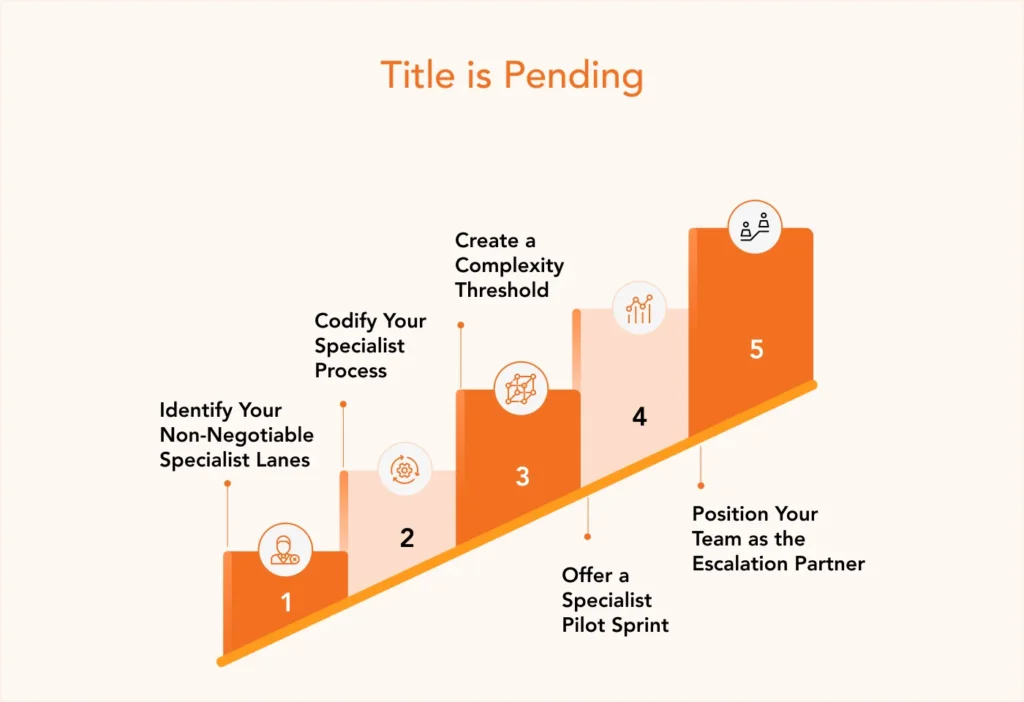
-
Identify Your Non-Negotiable Specialist Lanes
Choose 1–3 areas where you deliver depth the client cannot staff internally (e.g., headless builds, cross-platform reporting logic, advanced QA automation, multi-site governance).
-
Codify Your Specialist Process
Document your approach as a visible asset—architecture maps, QA flows, naming conventions, governance checklists. This makes your depth tangible and trustworthy.
-
Create a Complexity Threshold
Define a clear rule: when work remains in-house vs. when it gets escalated to you. (Clients love this—it removes uncertainty.)
For agencies formalizing these thresholds on the AI side, our breakdown of the three AI ownership models helps clarify who governs what.
-
Offer a Specialist Pilot Sprint
A short engagement (30–60 days) that demonstrates the depth layer: performance troubleshooting, architecture upgrades, analytics restructuring, experiment design.
-
Position Your Team as the Escalation Partner
Tell the client: “Your team handles velocity. We handle complexity.” It reframes dependence as smart delegation, not outsourcing.
This is how agencies move from “vendor who executes” to “partner who prevents fires.”
What Success Looks Like
If you run this play well:
- The client stops evaluating you on hours and starts evaluating you on outcomes.
- Internal teams rely on you for decisions, not tasks.
- You stabilize or even grow margin because you own the work that’s too expensive, too risky, or too technical for internal teams.
- You become the governance layer—the safety net that lets the client scale internal velocity without breaking their systems.
We’ve seen agencies retain high-value work during in-housing transitions by becoming the technical escalation partner—owning troubleshooting, architecture decisions, and advanced reporting—while internal teams handled day-to-day production.
Play 3 — Productize Smart
In-housing kills ad hoc work first.
Productization protects everything else.
Productize Smart means turning your repeatable workflows into standardized tools—audits, templates, dashboards, QA systems—that your client relies on whether they keep execution with you or bring it inside. It’s how agencies stay embedded in the hybrid delivery model: by owning the systems that make the work consistent, not the tasks that produce the work.
When the internal team uses your framework to do their work, you’ve become indispensable.
When to Use This Play
This play becomes essential when:
- Internal teams keep asking for “templates,” “examples,” or “best practices.”
- Projects slow down because in-house hires repeat preventable mistakes.
- The client wants more internal ownership but lacks processes.
- Your team keeps fixing the same problems week after week.
- The client wants predictability—without paying for full agency execution.
Productization works best when the client is trying to move faster but doesn’t yet have the systems to support that speed.”
How to Execute This Play
Here’s how you turn repeatable work into margin protection:
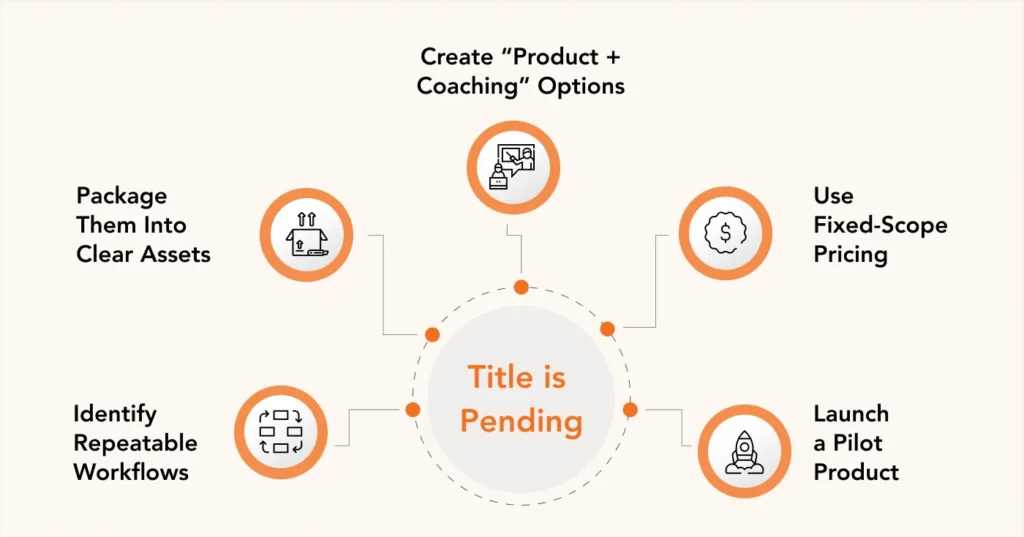
-
Identify Repeatable Workflows
Look for client-facing processes that happen often and inconsistently: QA, brand checks, analytics prep, naming conventions, sprint planning, governance steps, experimentation logs.
-
Package Them Into Clear Assets
Turn each workflow into a product: a diagnostic, checklist, template, training module, or dashboard. Make the value obvious and the steps unmistakable.
-
Create “Product + Coaching” Options
Don’t deliver the work—deliver the system. Offer a 30–60 day implementation sprint where you train internal teams while keeping strategic oversight.
-
Use Fixed-Scope Pricing
Productization eliminates uncertainty. Clients choose faster when they know the boundaries.
-
Launch a Pilot Product
Start with the simplest bottleneck: a QA framework, analytics hygiene checklist, or experiment roadmap. Solve one pain point, then scale.
This is how you shift from “agency that executes tasks” to “agency that builds systems.”
What Success Looks Like
You know this play is working when:
- Internal teams begin asking, “What does your template say?”
- The client uses your frameworks as their default operating system.
- Execution shifts internally, but you retain the systems, standards, and governance layers.
- Scope becomes more predictable because the work is standardized.
- Your margin improves—even if your hours decrease—because your value moved upstream.
We’ve seen agencies maintain their strategic seat during in-housing transitions by productizing their QA and experimentation frameworks—giving internal teams clear guardrails while the agency retained ownership of the system.
Play 4 — Co-Own Data
Execution moves in-house.
Data doesn’t.
Co-owning data means building the shared systems—dashboards, attribution logic, experimentation libraries, reporting standards—that both teams rely on to make decisions. When you own the intelligence layer, you stay inside every conversation that matters, even if the client shifts day-to-day execution internally.
This is the most defensible part of any agency in-housing strategy because internal teams can produce, but they can’t reliably interpret without a unified system.
When to Use This Play
Run this play the moment you see:
- The client asking for “access to reporting” or “more visibility.”
- Attribution breaks after work transitions inside.
- Data discrepancies show up between analytics and ad platforms.
- Internal teams start producing more volume but can’t explain performance changes.
- Performance conversations become reactive because no one owns the source of truth.
These are not data problems. They’re governance problems—and governance is where agencies stay irreplaceable.
This is the same dynamic that fuels Shadow AI — high ambition without guardrails.
How to Execute This Play
Here’s how you turn data into a shared operating system:
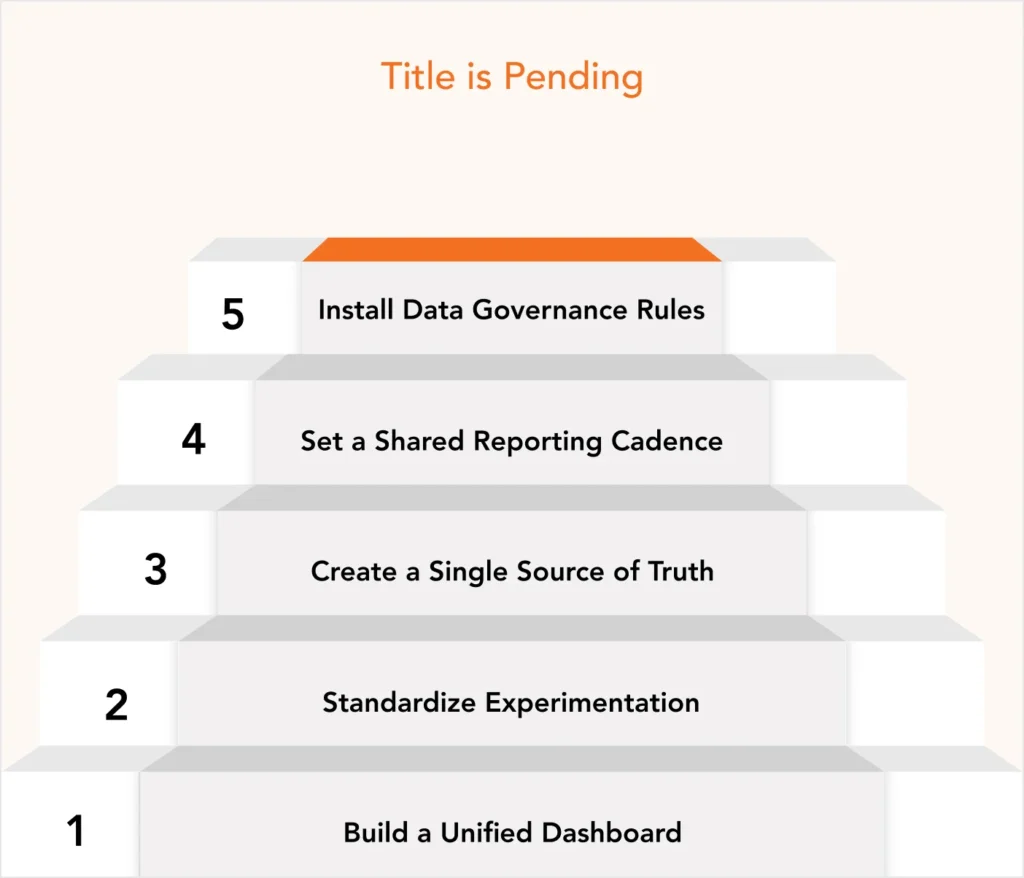
-
Build a Unified Dashboard
Create one shared dashboard with aligned definitions: conversions, attribution windows, platform discrepancies, experiment statuses, QA notes.
-
Standardize Experimentation
Install naming conventions, logging processes, and a simple library of “what we tested, what we learned, what we’re doing next.”
-
Create a Single Source of Truth
Define one place where decisions are made—your dashboard, your attribution logic, your QA framework.
-
Install Data Governance Rules
Permissions, version history, metric definitions, and error-checking—small details that prevent big fires. Internal teams lean on agencies heavily here.
When the data layer runs through you, the relationship becomes structural, not optional.
What Success Looks Like
If you run this play well:
- All teams—internal and agency—make decisions from the same source of truth.
- The agency becomes the interpreter and guardian of the client’s data ecosystem.
- Disagreements drop because definitions are unified.
- Attribution confusion stops eroding trust.
- Your role moves upstream, into system design and decision support.
- Scope stabilizes because the client needs your intelligence, not your hours.
We’ve seen agencies maintain strategic control during in-housing transitions simply by owning the experimentation library and dashboard logic—internal teams used their data structures daily, keeping the agency in every major decision.
Toolkit — White Label IQ’s In-Housing Readiness Assessment
Agencies don’t lose accounts because clients in-house work.
They lose accounts because they misread the risk until it’s too late.
That’s why we built White Label IQ’s In-Housing Readiness Assessment — a real-time, interactive diagnostic designed specifically for agencies navigating internal teams, shifting scopes, and hybrid delivery models. It gives you instant clarity on where each client stands and which moves will stabilize the relationship before renewal pressure hits.
This tool does in under a minute what used to require a two-hour internal meeting:
a clear, objective reading of your client’s in-housing trajectory — and what to do next.
What Your Results Mean
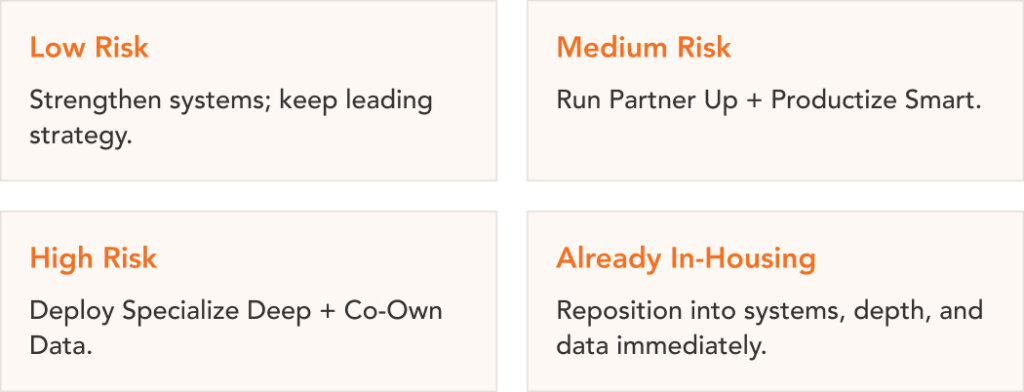
NEXT STEP: APPLY YOUR RESULTS
Your assessment will tell you exactly which play to run.
If you want support executing the technical depth, systems work, or reporting infrastructure behind that play, White Label IQ can sit beside you — quietly strengthening the parts of your model that in-housing pressures expose.
The Border Has Shifted — But You Can Redraw It
In-housing isn’t the villain. It’s the mirror.
It shows you what clients value now: speed, clarity, proximity — and partners who can strengthen the systems their internal teams run on. Execution may move inside their walls, but strategy, depth, and data don’t move without you.
Agencies that thrive in 2025 won’t fight the shift.
They’ll design the hybrid systems partner model that makes the shift work in their favor.
When you use the Four Plays — Partner Up, Specialize Deep, Productize Smart, and Co-Own Data — you stop defending your relevance and start architecting it. And when you pair those plays with the interactive In-Housing Readiness Assessment, you stop guessing where the risk lives. You see it instantly, and you act with intention.
The future of agency relevance is structural:
shared systems, co-owned data, clear governance, and specialist-level depth that internal teams depend on.
Not more hours.
More ownership.
Not more tasks.
More influence.
Not more volume.
More irreplaceability.
Your Next 2 Moves
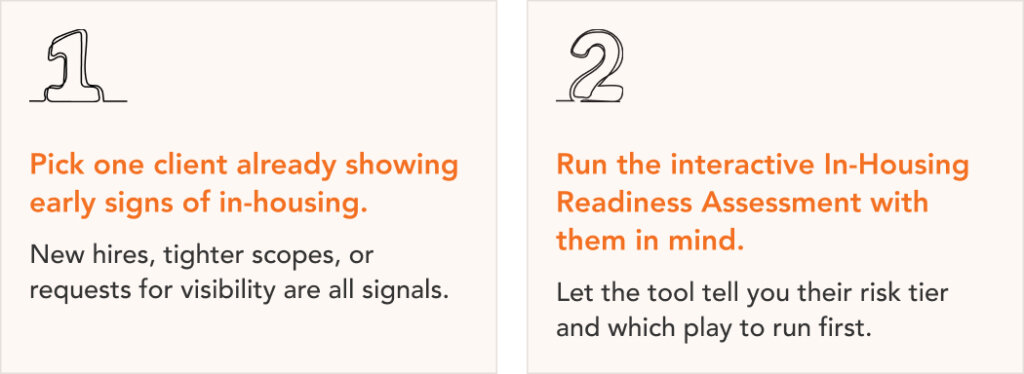
FAQs
What Triggers Client in-housing and How Can Agencies Stay Ahead of It?
Most in-housing begins when clients hire generalists, request more visibility, or struggle with inconsistent workflows. These are early signals, not threats.
Agencies stay ahead by shifting from task execution to systems ownership—co-owning data, dashboards, and governance. That moves you into a hybrid agency model where internal teams handle volume and you handle complexity, ensuring you stay essential even as roles evolve.
What is the Hybrid Agency Partner Model and Why is It Replacing Traditional Retainers?
The hybrid model blends in-house speed with agency depth. Clients keep day-to-day production, while agencies own systems, complex builds, experimentation, and data interpretation. It’s replacing retainers because it reflects real in-house vs agency workflow reality: brands want control, but not the risk of handling technical depth alone.
This model protects margin for agencies by anchoring them to infrastructure, not hours.
How Can Agencies Protect Margins When Clients Shift Work in-house?
Margins drop when agencies cling to execution instead of elevating their role. Protecting margin means owning the layers internal teams struggle with: architecture, analytics, QA, reporting logic, and governance.
These are high-value, low-volume areas that clients can’t staff cost-effectively. With a strong agency in-housing strategy, you trade hours for influence—stabilizing revenue even as scopes shrink.
What Parts of the Workflow Should Agencies Keep When Clients in-house Execution?
Keep the complexity: system architecture, experimentation frameworks, attribution logic, advanced reporting, build governance, and cross-platform troubleshooting. These areas require specialist depth, not generalists. Internal teams can handle velocity; agencies should own stability.
This keeps you integrated into every major decision and prevents you from becoming replaceable, even when day-to-day execution moves inside the brand.
How Do Agencies Know Which Clients Are at Risk of in-housing?
Risk shows up through behavior long before the announcement: tighter scopes, new internal hires, requests for process visibility, and more emphasis on speed.
The simplest way to see risk clearly is to use the interactive In-Housing Readiness Assessment—it immediately places clients into a risk tier and recommends which strategic play to run next, removing guesswork and emotion from the decision.